Overview
Artificial Intelligence (AI) is no longer a sci-fi idea; it is already changing a number of sectors, such as auditing and finance. AI is now a crucial component of contemporary audit workflows for chartered accountants (CAs), auditors, and CPA firms in India and globally. AI is revolutionizing auditing, making it faster, more accurate, and more compliant by automating repetitive tasks and offering deep data insights.
This blog will discuss the definition of artificial intelligence (AI) in the context of auditing, the reasons behind the adoption of AI audit software by audit firms, the best time to deploy these technologies, and how they improve the audit lifecycle as a whole.
AI in Audit: What Is It?
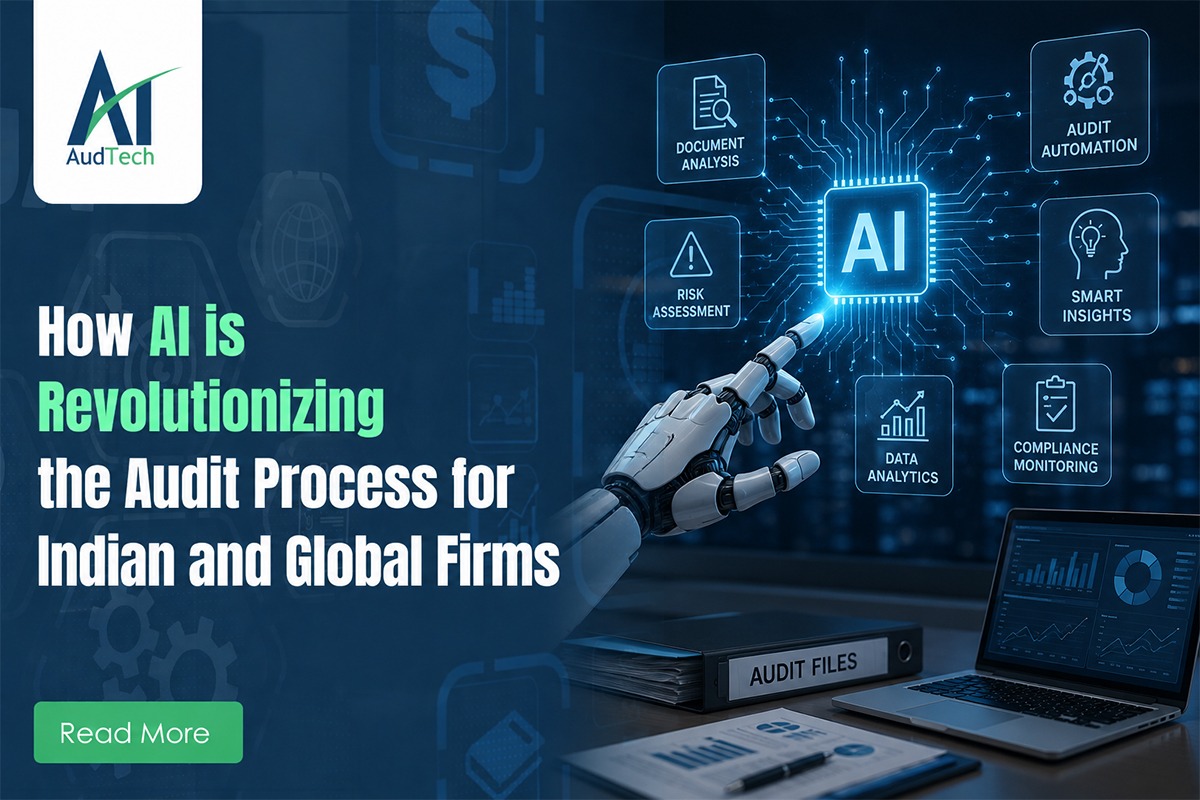
Artificial Intelligence (AI) in audit refers to the automation and improvement of audit processes through the use of machine learning, natural language processing, and data analytics. AI-enabled audit platforms process whole data sets in real time, identifying anomalies, conducting risk analysis, and producing insights that are beyond human capacity, in contrast to traditional audit tools that mainly rely on manual inputs and sampling.
The following are important AI-powered audit features:
- Automated review of transactions
- Risk prediction evaluation
- Real-time detection of anomalies
- Interpretation of documents in natural language
- Astute audit sampling
Why Is the Audit Industry Changing Due to AI?
1. Quickness and Effectiveness
Conventional audits entail laborious manual labor, including data collection, document verification, computation, and report preparation. This whole cycle is shortened by AI. Businesses in India can process thousands of transactions in a matter of minutes instead of hours or days. by utilizing AI-powered audit automation software.
2. Improved Accuracy
AI minimizes human error. Throughout the audit, it can apply consistent logic, cross-check entries, and validate documents. This lowers the possibility of oversight while also guaranteeing audit integrity.
3. Improved Fraud Identification
AI systems examine all data, not just samples. This facilitates real-time detection of anomalous trends, warning signs, and possible fraud. In the UAE and other regulatory-heavy areas, statutory audit software now frequently uses these intelligent auditing solutions.
4. Economicalness
Once put into use, AI-driven audit platforms help businesses maximize team bandwidth and eliminate the need for repetitive labor. Businesses can increase their clientele without adding employees, which boosts return on investment.
5. Reporting that is Ready for Compliance
AI assists businesses in keeping abreast of evolving regulations. You won’t ever be caught off guard during statutory filings or reviews thanks to automated updates to compliance modules, audit file management, and policy mapping.
How AI Is Applied in Important Audit Process Elements
1. Data collection and client communication
AI-driven chatbots and intelligent intake forms automate the process of gathering client data. These tools guarantee that all documents are submitted in the proper format and cut down on back-and-forth emails.
2. Data extraction and document analysis
AI is able to read and comprehend scanned documents, bank statements, invoices, and contracts through the use of NLP (Natural Language Processing). Businesses that deal with large volumes of documentation in accounts preparation software for CA firms will find this particularly helpful.
3. Planning for Risk-Based Audits
By examining past data, industry standards, and client-specific factors, AI algorithms assist auditors in prioritizing high-risk areas. A more efficient use of auditor time is ensured by this strategic planning.
4. Testing and Sampling
Statistical sampling tool is used in traditional audits. However, AI can intelligently detect outliers or inconsistencies in large data sets, enhancing the quality of audits.
5. Dashboards and Reporting
Automated reports with audit trails, risk scores, and compliance charts are produced by AI audit software. Both clients and auditors can benefit from the actionable insights these dashboards offer.
When Should Businesses Use AI-Powered Auditing Software?
The size, clientele, and expansion goals of your company will determine when to implement AI auditing tools. Nonetheless, there are a few obvious signs:
- You’re working with a lot of transactional data.
- Too much time is being spent on monotonous tasks by your team.
- You must enhance risk assessment and fraud detection.
- You are providing services to customers in regulated areas such as Africa or the United Arab Emirates.
- You want to grow without hiring more employees.
It’s time to look into AI-powered audit solutions if your CA or CPA firm fits even a few of the aforementioned requirements.
Adoption in the Real World: An International View
India
In India, businesses in Pune, Mumbai, and other financial centers are rapidly implementing AI audit software. AI-driven solutions are making businesses stand out in the face of growing competition and the need for quicker compliance.
Dubai and the UAE
AI is utilized in Statutory Audit Automation UAE solutions to manage complicated regulations with ease in places like Dubai, where statutory audits are required for the majority of businesses.
Africa
To address skill shortages, cut down on manual labor, and speed up audit turnaround times, audit firms in Kenya, Tanzania, Ghana, and South Africa are utilizing Digital Audit Solutions in Africa.
Advantages for Small and Mid-Sized CA Firms
The idea that AI is only for big businesses is a common misconception. Conversely, small CA firms without sizable audit teams benefit most from AI-powered audit analytics tools.
Platforms like AudTech provide smaller businesses with cloud-based audit workflow management software that is reasonably priced and allows them to:
- Automate file management and sampling
- Standardize the documentation used for audits.
- Effectively prepare financial statements and disclosures.
- Use centralized dashboards to interact with clients.
AI’s Potential in Audit
We can anticipate further AI integration in the future with:
- Blockchain for unchangeable audit records
- For complete automation, use RPA (Robotic Process Automation).
- Cloud integrations with accounting programs such as QuickBooks, Zoho, and Tally
- Rather than merely auditing problems, predictive insights can assist clients in preventing them.
AI won’t take the place of auditors, but auditors who use AI will replace those who don’t.
Conclusions
AI is now a necessity for contemporary audit firms, not an option. AI audit software offers businesses a competitive edge by improving compliance, automating tedious tasks, and offering deeper insights. Adopting the appropriate audit automation software can revolutionize your workflow, regardless of where you are located—Mumbai, Nairobi, Dubai, or Pune.
It’s time to think about an AI-powered solution like AudTech if you’re prepared to simplify your audits, cut down on errors, and prepare your company for the future.
CALL TO ACTION
For Indian and international businesses wishing to embrace digital transformation in audits, AudTech provides cloud-based audit workflow management software.
Go to https://audtech.co.in/
Dial +91 98600 03787 | +91 9112118221.
Visit this link to schedule your demo: https://bit.ly/3vBR3Wo
AI in Auditing: A Brief FAQ
Q1. AI audit software: what is it?
AI audit software automates and optimizes auditing tasks such as document analysis, risk detection, report generation, and sampling by utilizing artificial intelligence.
Q2. Can small CA firms use AI audit tools?
Indeed. Numerous cloud-based platforms, such as AudTech, are made to assist small and mid-sized businesses in increasing productivity through the use of AI-powered solutions.
Q3. How can artificial intelligence aid in the detection of fraud?
Artificial intelligence (AI) is more dependable for detecting fraud because it examines all transactions and spots irregularities that conventional sample-based audits might miss.
Q4. Does AI auditing adhere to UAE and Indian regulations?
Indeed. Regular updates are made to AI platforms to conform to national statutory audit laws and standards, such as those in the UAE and India.
Q5. Will AI take the place of human auditors?
No. Although AI helps auditors by managing repetitive tasks, human judgment, client communication, and strategic decision-making still heavily rely on human expertise.